 |
| ||||||






Inverter fault
Battery fault
UPS
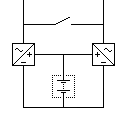
An UPS will protect your mission critical equipment from Power Outage in the utility grid, but without monitoring the batteries it may give a false sense of security.UPS stands for Uninterruptible Power Supply. There are several possible operating principles for an UPS. The most reliable setup is the continuous mode UPS, this is truly uninterruptible since the AC-output is always derived from an inverter in which DC-current from a battery is continuously being converted into AC.
Under normal conditions, when Utility Power AC is available, a rectifier is charging the battery with the same amount of current that is being required by the inverter to supply the load, thus, the net battery current is close to zero.
In the event of a utility power failure the battery charging will stop, while the inverter continues to supply AC-current to the load until the battery is discharged.
There is no electronic or mechanical switching involved, the output side of the UPS works in the same mode regardless of the presence or absence of AC current at the input side. However, there is an electrochemical switch over inside the battery cells.
The battery must be able to instantly reverse it's operating mode from standby to maximum power discharge, at all times! Otherwise, your power supply might not be as uninterruptible as you may think.
Automatic Bypass Switch
An UPS can of course, like all technical systems, fail for various reasons. To prevent an internal malfunction from being the cause of a power-fail, a bypass switch will automatically connect the incoming utility power directly to the outgoing line in case of a fault in the rectifier or inverter.Without this alarm signal an internal fault could infer in believing that you have a safe power supply even though the UPS actually is bypassed. In many cases this could be worse than to not have an UPS at all.
Alarm Signal
The single most important function in the UPS is the alarm signal that warns you if the UPS is unable to take over the power supply for your critical load. The alarm will be sent when the UPS is in bypass mode or when the incoming AC is lost.No Warning for Battery Faults
More than 90% of UPS failures are related to the battery. All batteries are consumption articles and requires replacement on a regular basis. Unfortunately, the UPS is unable to detect battery faults and therefore no alarm will be sent to indicate battery failure.A typical UPS battery comprises about 200 cells that are connected in series. Each individual cell must be able to handle the total current required by the load. An open-cell condition in any of the 200 cells will render the whole battery useless.
Battery Monitoring
A separate Battery Monitoring System is required to verify that the battery is in full operating condition, and to be able to detect single cell faults that could jeopardize the reliability of your back-up system. A battery problem is as severe as any other malfunction in the UPS, and the alarm signal from the battery monitor must be regarded the same as if the UPS is in Bypass mode.All batteries are aging and deteriorates by time. Some cells will depreciate faster than others, and may need to be replaced sooner than the rest of the battery. However, replacing the whole battery before it's absolutely necessary implies an increased risk for battery faults and of course, unnecessary costs. Battery monitoring is required for reliability, but will also optimize overall battery economy.
The UPS-Battery

← The picture to the left shows a typical UPS battery configuration with 2 strings, comprising 240 cells each, totally 480 cells.
The most critical component in a UPS system is the battery. If the battery fails when there is a utility power fail, you will also lose power to your protected load.
An internal fault in the UPS or a problem with the motor-generator set is usually not a critical condition, an alarm signal will give you an early warning before the power is lost. A fault in the battery is much more serious since battery problems are not easily detected when the UPS is in normal stand-by mode.
When the UPS is in standby, the battery is in float charge mode with a very small charging current corresponding to the battery’s self-discharge current. The UPS does not know if the battery is good or bad. In fact, the battery can even be disconnected and the UPS will continue to work as usual, assuming it has a functioning battery backup.
At a loss of incoming utility power, the battery must be able to instantly switch from float charge to full discharge current. This puts great pressure on each cell in the battery.
Cells are connected in series
The UPS battery is especially vulnerable to failing cells simply because of the share number of cells needed to get the required battery voltage of about 400 Volt. A typical UPS-battery comprises between 180 and 240 cells in series.The obvious disadvantage with having the cells connected in series is that if one single cell fails, the whole battery may collapse. The more cells in series, the greater the risk of a battery failure.
Like a Car-battery
 A 12V car battery comprises six 2V cells connected in series. Most car owners are aware of the fact that it is quite
possible for the battery to fail to crank the engine fast enough to start. Such fault is usually caused by a problem
in only one of the six cells, the fact that the other five cells may be in perfectly good shape won't matter.
A 12V car battery comprises six 2V cells connected in series. Most car owners are aware of the fact that it is quite
possible for the battery to fail to crank the engine fast enough to start. Such fault is usually caused by a problem
in only one of the six cells, the fact that the other five cells may be in perfectly good shape won't matter.
... but not quite so
The big difference between a car battery and a UPS battery is that the car battery is tested several times a day, every time the car is started, and the UPS battery is very rarely tested. At each test you will notice if the battery has worsen, and you may decide to replace it to make sure it will work the next time you need to use it.When your car battery deteriorates you will notice little by little, long before it is completely useless. When the UPS-battery gets worse it won't show at all between the tests, it will either work at the next power-outage, or not!
The fact that the UPS-batteries almost never gets tested and consists of a lot more cells than a car battery makes the probability of an interruption in the UPS significantly larger than that you would not be able to start your car.
Parallel connected battery strings
To provide a higher effect and/or longer running time the UPS-battery can be configured with two or more parallel battery strings, where each string has to consist of the right amount of cells. The strings usually connects in the outer ends and if separate power switches are used the battery can serve during normal stand-by mode.
OBS! A larger amount of battery strings does not limit the risk for a power outage caused by a battery fault! It just leads to even more vulnerable cells.
Monitoring the UPS battery
To make sure that your UPS battery is in good condition at all times, it must be monitored. By continuously measuring the battery current and each individual cell or block voltage, faults can be detected in an early state.Battery cells can be replaced as soon as a fault is detected and the overall power system’s reliability is increased significantly, at the same time as optimal working condition is guaranteed for the rest of the battery.
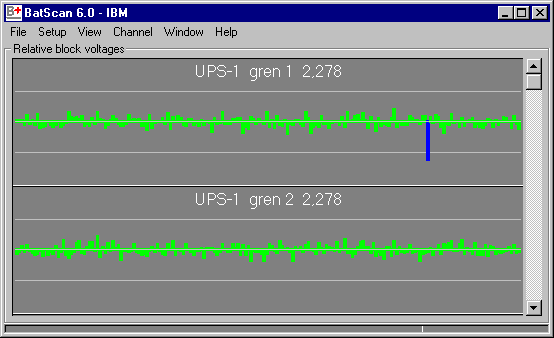
An advanced battery monitoring system can also identify cells that are about to worsen by analyzing each cell’s ability to resist the change of current that occurs at a power outage. This is a far more conclusive test than just measuring AC conductance, i.e. the inverse of impedance.
What is your UPS-battery configuration?